Cortag Duo vs Flex 115 mm Porcelain Diamond Blades | Buying Guide
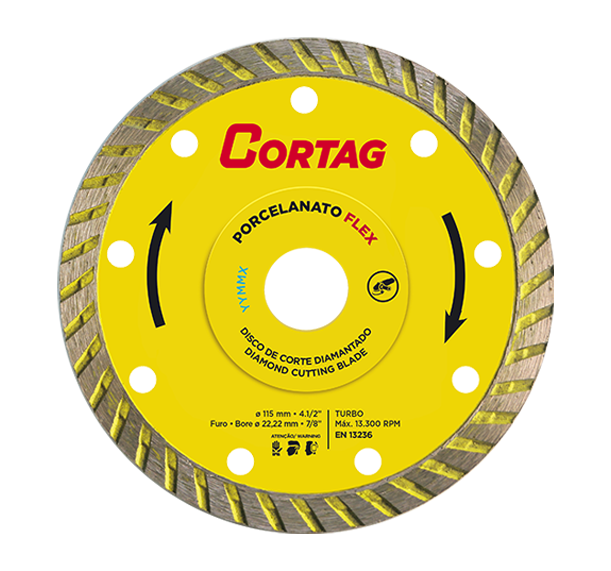
Cortag Duo 63194 and Flex 61577 are both published 115 mm porcelain diamond discs at MBMC. Different product lines do not prove one is best for every cut. The Flex listing identifies turbo design, 1.2 mm thickness and 22.22 mm bore; verify Duo's own recorded specifications before deciding on cutting mode or kerf. Match any disc to the grinder, arbor, rated speed and manufacturer-approved materials.
This is a practical Saudi buying comparison of published Cortag models and documented specifications, not unsupported performance claims.
Selecting 115 mm porcelain blades for tool and material compatibility
Nominal diameter alone is not enough. Confirm disc-rated RPM, tool spindle/bore and any manufacturer-approved reduction ring, permitted dry/wet cutting and guard compatibility. Never remove the grinder guard or use a cutting disc for side grinding without approval. Control respirable silica dust when cutting ceramic and porcelain.
Verify the exact Cortag 63194 or 61577 model and package.
Compare the 115 mm disc diameter, bore and maximum rated speed with the grinder.
Verify approved porcelain applications and wet or dry operating mode.
Inspect for cracks or damage; never operate a damaged disc.
Use guards, dust controls and suitable eye, hearing and respiratory protection.
Confirm the exact disc's compatibility on representative material before ordering project quantities.
Which option fits your project?
For professional porcelain work, identify the machine, material, approved disc speed and duty conditions first. A different brand cannot resolve incompatible equipment. Diamond tile discs have different applications from metal and stainless cutting wheels.
Mistakes to avoid
Mounting a disc with incompatible arbor or speed rating.
Assuming Duo and Flex specifications match because both are 115 mm.
Cutting without a guard or silica dust controls.
Using higher price as a guarantee of cleaner cuts without a proper test.



 Tiles & Ceramics