


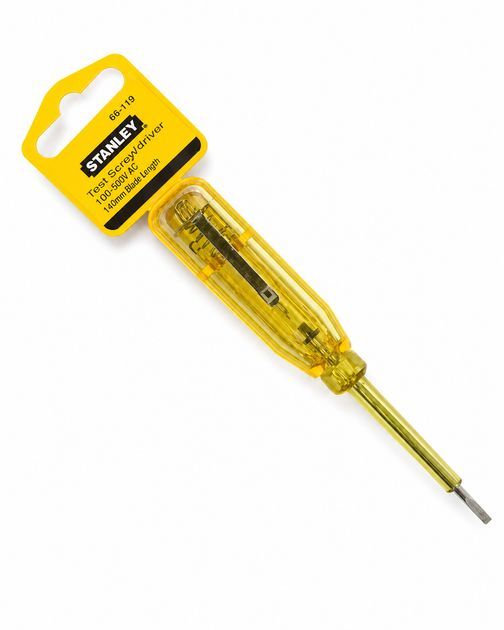
STANLEY Tester Screwdriver 66-119 vs 66-120 | KSA Guide
Choosing a STANLEY electrical tester screwdriver for a Saudi maintenance team? The confirmed catalogue difference between models 66-119 and 66-120 is the blade size: 3×50 mm versus 5×100 mm. Both are listed as indicator-type tester screwdrivers. An indicator screwdriver on its own is not an approved means of proving a circuit is de-energised before electrical work.
Review the exact products: STANLEY 66-119 3×50 mm (SKU ST2-I71027) and STANLEY 66-120 5×100 mm (SKU ST2-I71028).
66-119 versus 66-120: verified catalogue differences
| Attribute | 66-119 | 66-120 |
|---|---|---|
| Listed blade width | 3 mm | 5 mm |
| Listed blade length | 50 mm | 100 mm |
| MBMC SKU | ST2-I71027 | ST2-I71028 |
| Product listing | View 66-119 | View 66-120 |
These size differences alone do not establish a wider approved voltage range, greater electrical safety or better detection accuracy for either model. Verify any electrical rating and instructions against official manufacturer documents and the exact item packaging.
What is different from a normal screwdriver?
A conventional screwdriver is designed for compatible screw heads. The catalogue describes these tester models as including an indicator light for electrical detection under their specified conditions. This does not turn them into multimeters, qualified two-pole voltage detectors or reliable indicators under every condition. Electrical work requires trained personnel and appropriate procedures.
Purchasing for a Saudi building-maintenance contractor
Record the exact model, task, relevant manufacturer instructions, authorised user and number of workers requiring the equipment. A longer blade is not automatically safer than a shorter blade. Blade width and length are dimensional specifications, not substitutes for verified ratings, test methods and suitability for the intended environment. Competent technicians may require other approved testing instruments; those are not included in either linked product.
Critical electrical safety limits
Do not treat a dark indicator as proof that a circuit is dead. Unqualified personnel should never probe exposed wiring, distribution boards or sockets. Qualified electricians must use suitable isolation, lockout, verification and instrument testing procedures. Tester condition and operating conditions matter, and an indicator may fail to show hazards.
Saudi stock, checkout and repeat purchases
Both models appear as published products in MBMC's Zid catalogue, but an indexed storefront version showed an unavailable status despite internal stock records. Confirm actual add-to-cart and address-specific checkout eligibility before relying on immediate supply. Prices and delivery are dynamic, so this article makes no fixed-price or delivery promise. Review shipping and payment policies. Use exact model and merchant SKUs for repeat procurement rather than a vague 'small tester screwdriver' description.
Frequently asked questions
Is the 5×100 mm tester more accurate than 3×50 mm?
Accuracy cannot be inferred from blade width or length. Consult the approved electrical specifications and operating requirements.
Can I use one to confirm a wire is safe to touch?
No. Do not rely on an indicator screwdriver alone to prove absence of voltage; electrical inspection requires competent personnel and approved equipment.
How do I identify the two STANLEY models?
66-119 is listed as 3×50 mm; 66-120 is listed as 5×100 mm. Check the exact model identifier.
Can a contractor order multiple units?
Review the product listings for quantities the live store can actually supply, and ensure the equipment is appropriate for the employer's electrical safety procedures.
Compare exact products
Open the STANLEY 66-119 listing or STANLEY 66-120 listing, review the required specifications and confirm checkout availability for your Saudi delivery address.