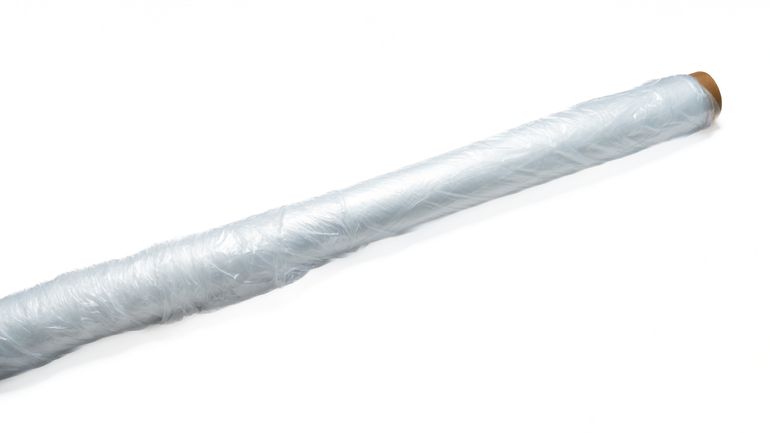
Quick answer: Selecting polyethylene construction sheeting requires checking more than thickness. Consider sheet dimensions, polymer type, tear and puncture resistance, fixing method and expected sun and wind exposure. Products described as 150 or 300 microns may suit different covering tasks, but thickness alone does not establish waterproofing, vapor barrier performance or UV resistance.
150 vs. 300 Micron Plastic Sheeting
Property | 150 microns | 300 microns |
|---|
Nominal thickness | 0.15 mm | 0.30 mm |
Potential application | Selected temporary covering jobs | Jobs requiring a thicker film where specified |
Puncture and tear resistance | Depends on polymer and manufacturing | May improve with thickness but is not guaranteed |
Weight at equal area | Typically lighter | Typically heavier |
UV durability | Requires an explicit UV rating | Also requires an explicit UV rating |
What Does Micron Thickness Mean?
One micron is one thousandth of a millimeter. Thus 150 microns is 0.15 mm and 300 microns is 0.30 mm. Thickness does not identify material grade or independently prove performance.
Choose Sheeting by Application
Task | Specification to check |
|---|
Dust protection | Sheet size, fastening and strength |
Temporary rain cover | Seams, overlaps, water management and product suitability |
Outdoor sun exposure | Documented UV stabilization and allowed exposure period |
Floor protection | Slip and puncture resistance and finish compatibility |
Engineered vapor barrier | Approved permeance, puncture and installation specifications |
Can General Sheeting Be Used as a Vapor Barrier?
Not automatically. Vapor or moisture barriers may require defined water vapor permeance, puncture resistance, seam detailing and engineering approval. Do not replace a specified building system component with generic protective film.
How to Estimate Sheeting Quantity
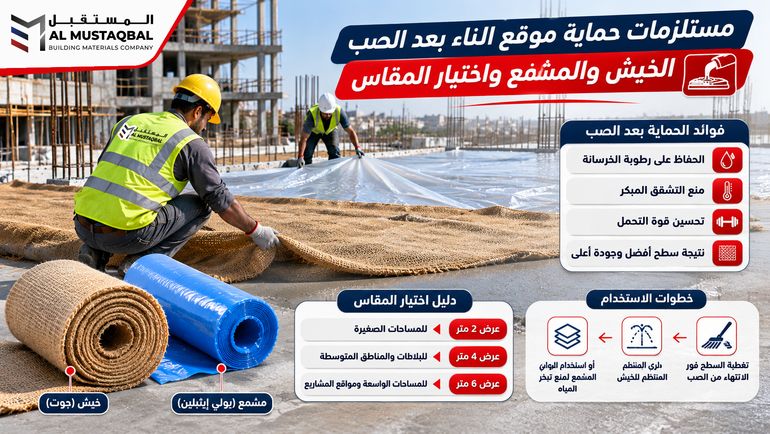
Multiply length by width to calculate the theoretical area. For example, 4 by 10 meters equals 40 square meters before overlaps, trimming and waste. Allow extra material according to the actual site layout.
Common Mistakes
- Choosing based only on microns without checking strength.
- Leaving covers unsecured in wind.
- Assuming all thick film is UV resistant.
- Trapping moisture around materials needing ventilation.
- Allowing rainwater to pool on the cover.
- Using general-purpose film as a permanent structural barrier.
Shop Construction Tarpaulins and Sheeting in Saudi Arabia
Browse construction covers and sheeting and tarpaulins at Al Mustaqbal Building Materials Store. Confirm dimensions, thickness, material and environmental limits before ordering.
Frequently Asked Questions
What is the difference between 150 and 300 micron film?
300 micron film has twice the nominal thickness, though mechanical strength also depends on the specific material.
Is 300 micron film UV resistant?
Only where the product has documented UV performance.
Can covering film serve as a vapor barrier?
Only when its certified properties and installation meet the approved system.
How do I choose roll size?
Measure the required area and include sufficient overlap and fastening allowance.
Does thicker film prevent all tearing?
No. Thickness alone cannot guarantee resistance to damage.
Conclusion
Select sheeting based on documented properties and application needs, not nominal microns alone. Explore construction sheeting.
Related Products in Our Store
Check product details, specifications and availability before ordering.



 Building Materials